
A hidden leak under my floor is something to investigate promptly, because water can escape for days or weeks before anything visible shows up. Common causes include ageing pipework, failed joints, corrosion, accidental pipe damage, heating-system leaks and problems with the incoming water supply pipe.
The first priority is not to start pulling up flooring. It is to work out whether water is still escaping, limit further damage where you can, and arrange accurate leak detection. Most expensive hidden-leak problems we see come from guessing too early rather than acting too late.
Why might I have a hidden leak under my floor?
A hidden leak under your floor can be caused by damaged pipework, a failed joint, corrosion, freezing, movement, accidental damage or a leak from the central heating system. Water can also travel from another location, so the wettest part of the floor is not necessarily directly above the leak.
| Possible cause | What may be happening |
|---|---|
| Ageing pipework | Pipes can deteriorate over time |
| Failed pipe joint | A joint may begin releasing small amounts of water |
| Corrosion | Older metal pipework may develop pinhole leaks |
| Accidental damage | Screws, nails or building work may damage concealed pipes |
| Freezing | Water freezing inside pipework can cause damage |
| Heating pipe leak | A flow or return pipe beneath the floor may be leaking |
| Supply pipe leak | The incoming mains water pipe may be damaged |
| Waste pipe leak | Water may escape only when a bath, shower or appliance is used |
Ofwat explains that pipes can deteriorate or be damaged by factors including freezing, movement and general asset condition. Our water leak detection services cover homes and businesses across Bedfordshire, Hertfordshire, Buckinghamshire and North London.
How do I know if I have a hidden water leak under my floor?
You may have a hidden water leak under your floor if you notice unexplained damp patches, damaged flooring, mould, a constant sound of running water, reduced water pressure or unexpectedly high water usage. If you have a water meter, movement when no water should be in use is another strong sign.
Warning signs of a hidden water leak under your floor include:
One sign alone does not prove there is a pipe leak. Proper investigation is what matters, which is why our water leak repair service starts with tracing the source rather than guessing.
What should I do first if I suspect a leak under my floor?
If you suspect an active hidden leak, your first priority is limiting further damage. If it is safe and appropriate, turn off the incoming water at the internal stop tap, check whether the water flow stops, and contact a professional plumber or leak detection specialist.
A sensible first checklist is:
- 1Check whether water is visibly spreading.
- 2Locate the internal stop tap, often under the kitchen sink.
- 3Turn off the water if there is an active leak and it is safe to do so.
- 4Do not force a seized stop tap.
- 5Keep away from wet electrical equipment.
- 6Move possessions away from affected areas where safe.
- 7Take photographs of visible damage for insurance.
- 8Contact a plumber or leak detection specialist.
If the leak is severe and water is approaching sockets or a consumer unit, do not touch wet electrical fittings. Get professional help. Our emergency plumber service is available for active leaks.
Can I use my water meter to check for a hidden leak?
Yes. If you have a water meter, you can use it as an initial check for an unexplained mains water leak. Make sure taps and water-using appliances are off, wait for cisterns and tanks to finish filling, record the reading, then check it again later without using any water in between.
If the reading has climbed, there could be a leak. There are limits to this test, though. A water meter generally shows water escaping from the metered mains supply. It may not show a leak in a sealed central heating circuit, because heating water does not pass through the household meter.
The WaterSafe guide to finding a water leak walks through the meter test and the common signs to watch for.
What if my boiler keeps losing pressure as well?
If your boiler repeatedly loses pressure and you cannot see a leak around the boiler, radiators or exposed pipework, a concealed central heating leak is one possible explanation. Heating pipes often run beneath floors, inside walls or through other inaccessible areas, so small leaks can be hard to spot.
Useful information to give a heating engineer includes:
- how quickly the pressure falls
- whether it falls with the heating on or off
- whether any radiators need frequent bleeding
- whether you have noticed damp or warm floor areas
- whether the problem began suddenly or gradually
Do not keep repressurising the boiler without investigating why the pressure is disappearing. Our guide to a boiler that keeps losing pressure explains what to check, and our central heating repair service covers concealed heating pipe leaks.
Why is my floor wet if the leak is somewhere else?
Water does not necessarily appear directly beneath the damaged pipe. It can travel along pipes, joists, insulation, floor voids and building materials before becoming visible. That is why simply cutting into the floor at the first damp patch may miss the actual source.
For example, water from a bathroom connection can run along a joist and appear in another room, and an upstairs leak can show up as damp flooring or staining downstairs. Accurate diagnosis should always come before destructive investigation.
Should I lift my floor to find the leak?
No, not normally. You should not start lifting flooring or breaking into a concrete floor until the likely leak location has been narrowed down. Unnecessary excavation can damage flooring, pipes and cables and can increase repair costs considerably. Professional detection can often identify a much smaller target area first.
Depending on circumstances, professional investigation may involve:
- moisture measurement
- pressure testing
- acoustic leak detection
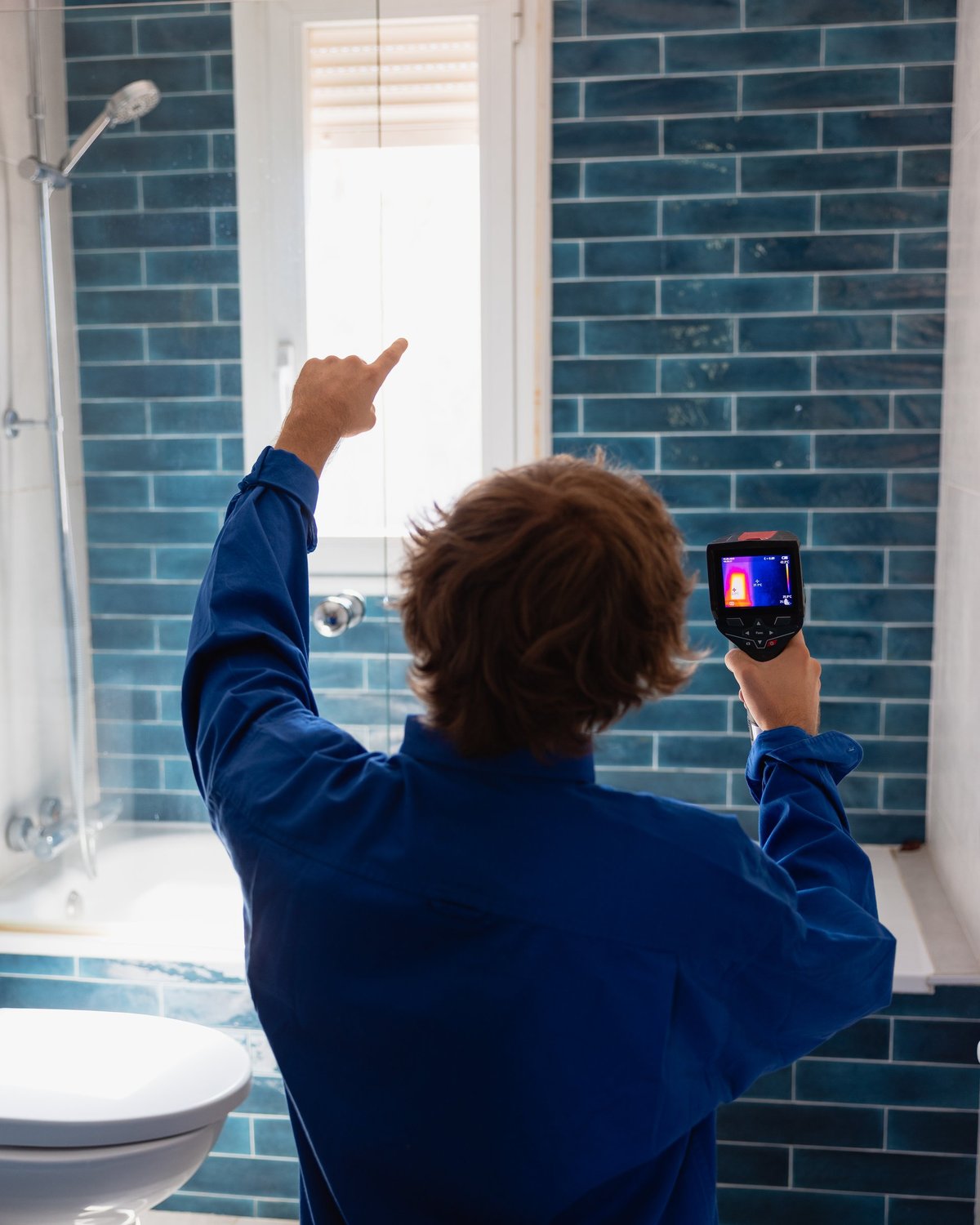
- thermal imaging
- inspection of accessible pipework
- tracer methods
- water meter testing
- central heating pressure testing
Not every technique suits every leak. A competent engineer should choose the method based on the pipework, flooring and symptoms, not automatically recommend that a large area of floor comes up. Our professional leak detection service uses non-destructive methods wherever it can.
What does it mean if part of my floor feels unusually warm?
An unexplained warm patch on the floor can sometimes indicate hot water escaping from a concealed heating or hot-water pipe, particularly where pipes run under the floor. Heating pipes can also make parts of a floor warm naturally, so a warm area alone does not prove a leak.
Look for accompanying symptoms such as:
- boiler pressure dropping
- dampness
- flooring changes
- increased water usage
- unusual heating-system behaviour
If several symptoms appear together, further investigation is sensible.
Who is responsible for a hidden pipe leak?
Responsibility depends on which pipe is leaking. In England and Wales, the water company generally maintains the water mains and communication pipes, while homeowners are normally responsible for their private supply pipe and the plumbing inside the property. Shared supply pipes can involve joint responsibility.
If you suspect the leak is on the incoming supply pipe, also contact your water company, because some offer leak investigation, repair assistance or leakage allowances.
Ofwat explains that a homeowner is normally responsible for the supply pipe running from the property boundary into the home, although individual circumstances can differ. The Ofwat guidance on your water supply sets out who is responsible for what.
What UK regulations apply to concealed pipes under floors?
In England and Wales, the Water Supply (Water Fittings) Regulations 1999 apply to plumbing carrying water supplied by a water undertaker. They require suitable fittings and aim to prevent waste, contamination and undue consumption of water, with specific requirements about fittings concealed beneath floors and within structures.
In practical terms:
- Regulation 3 says water fittings must not be installed or used in a way that causes, or is likely to cause, waste, misuse, undue consumption or contamination.
- Schedule 2 provides that a water fitting must not be embedded in a solid floor.
- Joints and fittings that need operation or maintenance must not be concealed in inaccessible positions.
- Concealed fittings must meet specified requirements.
This does not mean every water pipe under a floor is automatically unlawful. The installation method, pipe material, accessibility, type of fitting and circumstances all matter.
The Water Supply (Water Fittings) Regulations 1999 are worth reading if you are having pipework altered or installed beneath a floor.
Can a hidden leak increase my water bill?
Yes. If the leak is on your metered mains water supply, water escaping continuously can raise your bill even when the leak is hidden. If you notice an unexplained rise in consumption, investigate promptly and ask your water company whether a leakage allowance may be available after the repair.
Keep records for any allowance or insurance claim:
- photographs of the damage
- plumber reports
- invoices
- meter readings
- dates of discovery and repair
Repairs we carry out on visible, accessible pipework are covered by our plumbing repairs service.
When should I call a leak detection plumber?
Arrange professional leak detection when you have continuing dampness, unexplained meter movement, recurring boiler pressure loss, the sound of running water, damaged flooring or other evidence of a leak but cannot see its source. Early investigation can reduce both water loss and unnecessary damage to your property.
Professional help is particularly sensible if:
- the leak appears to be beneath a concrete floor
- expensive flooring would need removing
- you cannot identify which pipe is leaking
- your boiler repeatedly loses pressure
- water continues escaping after basic checks
- several possible water sources exist
- the problem keeps returning
Our emergency water leak detection is there for urgent cases, and our burst pipe repairs cover sudden failures under floors.
Frequently asked questions
How do I know if a pipe is leaking under my floor?
Look for damp flooring, mould, unexplained water usage, a running-water sound, reduced pressure, damaged flooring or recurring boiler-pressure loss. Professional leak detection may be needed where there is no visible source.
Can I have a water leak without seeing any water?
Yes. Water can stay beneath flooring, within insulation, behind walls or inside structural voids for some time before visible damage appears.
Will my water meter detect a leak under my floor?
It can help identify a leak connected to the metered mains water supply. It will not necessarily identify a leak within a sealed central heating circuit.
Should I turn my water off if I suspect a hidden leak?
If you believe there is an active water leak and it is safe to do so, turning off the internal stop tap can limit further water loss while professional help is arranged.
Can a hidden leak damage my floor?
Yes. Depending on the materials, prolonged moisture can cause swelling, staining, movement, deterioration of finishes and damage to surrounding building materials.
I think I have a hidden leak under my floor. What next?
If you suspect a hidden leak under your floor, do not ignore it just because you cannot see running water. Identify the symptoms, limit further water loss, work out which system may be leaking, locate the leak accurately, then repair the source and dry the affected area.
National Plumbing can investigate suspected hidden water leaks and help identify the source before unnecessary flooring is disturbed.