
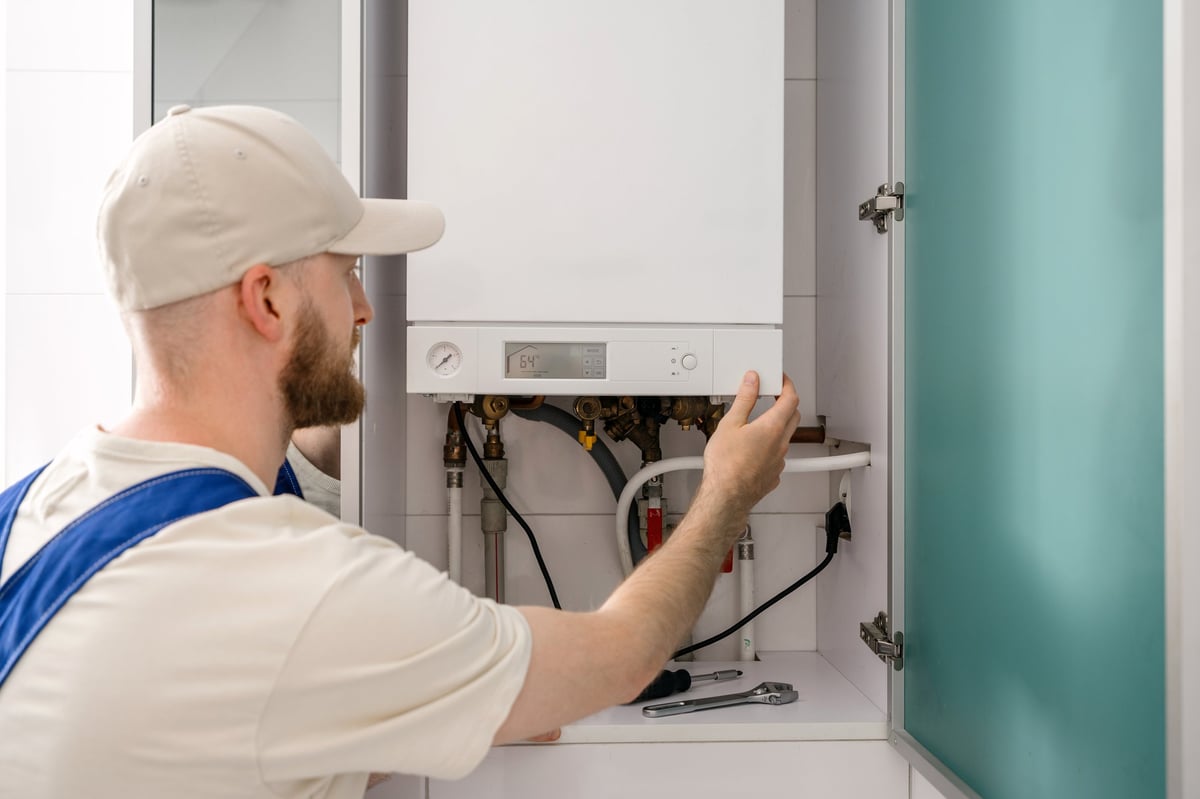
Replacing an old boiler is not simply a case of buying the newest version of the appliance already on your wall. The right replacement depends on your property's heating demand, hot-water requirements, existing pipework, water pressure, controls, system condition and how you expect to use your home in the years ahead. Taking time to assess these points before installation can help you avoid an oversized boiler, disappointing hot-water performance or unnecessary additional work later.
When should you consider replacing an old boiler?
Replacing an old boiler may make sense when breakdowns become frequent, important components are becoming difficult or expensive to obtain, repair costs are increasing, or the boiler can no longer reliably meet your heating and hot-water needs. Age alone, however, does not automatically mean a boiler must be replaced.
Before deciding, consider:
- How frequently is it breaking down?
- What would the next repair cost?
- Are replacement parts readily available?
- Does it heat the property evenly?
- Does it provide enough hot water?
- Is the boiler showing signs of corrosion or water leaks?
- Is its efficiency poor compared with modern alternatives?
A professional assessment can help you compare the likely cost of repairing your existing appliance with replacement. Speak to us about a boiler repair or an annual boiler service first if repairs look feasible.
Should you replace your boiler with the same type?
You do not necessarily need to replace an old boiler with the same type. A heating engineer should assess your household's hot-water demand, available space, water pressure, existing cylinder, radiators and pipework before recommending a combi, system or regular boiler. What worked twenty years ago may not be the best solution today.
| Boiler type | Often suitable for | Important consideration |
|---|---|---|
| Combi boiler | Smaller and medium-sized homes | Hot water is provided on demand |
| System boiler | Homes with greater hot-water demand | Usually works with a hot-water cylinder |
| Regular boiler | Certain traditional heating systems | May retain tanks and a cylinder |
A large household using several showers or bathrooms at once has different needs to a one-bedroom flat. Learn more about boiler installation or combi boiler installation.
How do you choose the correct boiler size?
The correct boiler size should be based on the property's heating load and hot-water requirements rather than simply copying the kilowatt rating of the old boiler. An unnecessarily powerful boiler does not automatically heat your home better and may not allow the system to operate as efficiently as intended.
An installer should consider factors including:
- property size
- insulation levels
- number and size of radiators
- heat loss
- number of bathrooms
- hot-water demand
- mains water flow and pressure
- existing pipe sizes
Ask your installer why a particular boiler output has been recommended rather than choosing solely on headline kilowatt figures. For the wider system, see our central heating repairs service.
What should be checked before replacing an old boiler?
Before replacing an old boiler, the whole heating system should be considered. The new appliance will still rely on existing radiators, valves, controls and pipework, so fitting a high-quality boiler onto a poorly maintained system may not deliver the performance or reliability you expect.
Boiler replacement checklist
- Has the heating requirement been assessed?
- Has mains water pressure and flow been checked?
- Are the existing radiators suitable?
- Is the pipework correctly sized?
- Does the system contain sludge or corrosion?
- Will the system be cleaned before commissioning?
- Will corrosion inhibitor be added?
- Are heating controls included?
- Is a magnetic system filter recommended?
- What warranty is included, and who registers the installation?
Industry guidance in BS 7593:2019+A1:2024 covers cleaning, protection and maintenance of domestic central heating systems. Current HHIC guidance also emphasises appropriate system cleaning and water treatment. A central heating power flush is often part of a proper boiler change.
What heating controls should you consider with a new boiler?
Modern heating controls can help a replacement boiler respond more effectively to the amount of heat your home actually requires. Depending on the system, options may include programmable thermostats, thermostatic radiator valves, load compensation, weather compensation and compatible smart heating controls.
For homes in England, the government's Boiler Plus standards introduced additional efficiency requirements for domestic boiler installations. These include time and temperature controls, while combination gas boiler installations require an additional efficiency measure such as load compensation, weather compensation, flue gas heat recovery or qualifying smart controls.
The aim is not just an efficient boiler, but an efficient whole system. Explore heating controls installation when planning your replacement.
Do you need a Gas Safe registered engineer to replace a gas boiler?
Yes. If you are replacing a gas boiler, gas work must be carried out by an appropriately qualified Gas Safe registered engineer. Do not assume that someone is qualified simply because they describe themselves as a plumber or heating engineer; check that their Gas Safe registration covers the work being undertaken.
The Gas Safety (Installation and Use) Regulations 1998 govern important aspects of gas work in Great Britain. The Health and Safety Executive confirms that anyone employed to work on domestic gas appliances must be Gas Safe registered and competent for the relevant category of work.
Read the HSE gas safety guidance for homeowners. You can also see our Gas Safe registered engineer services.
Does replacing a boiler need Building Regulations approval?
A replacement boiler is generally subject to Building Regulations requirements. In England, appropriately registered installers can normally self-certify qualifying work and notify the relevant authority through the applicable scheme, rather than the homeowner making a separate Building Regulations application. Keep the resulting compliance certificate safely.
GOV.UK identifies boilers as an example of work that can be self-certified by appropriately registered tradespeople. A compliance certificate is useful evidence that the installation meets applicable standards and may be requested when the property is sold. Read the GOV.UK competent person scheme guidance.
Energy-efficiency requirements for homes in England are addressed through Part L of the Building Regulations 2010 and its associated Approved Document guidance. Rules differ across Scotland, Wales and Northern Ireland, so check local requirements.
Should you consider a heat pump before buying another boiler?
Before replacing an old boiler, it can be sensible to consider whether a heat pump is suitable for your property, particularly if you plan to stay long term. Heat pumps are not appropriate for every situation, but comparing the options before committing to another heating system can be worthwhile.
The Boiler Upgrade Scheme currently provides support towards eligible low-carbon heating installations in England and Wales. As of September 2026, standard support includes £7,500 towards eligible air-to-water or ground source heat pumps, with different amounts applying to some technologies and qualifying off-gas properties. Read the GOV.UK Boiler Upgrade Scheme guidance. A good installer should explain the practical differences rather than pushing one technology regardless of the property.
What should be included in a boiler replacement quotation?
A boiler replacement quotation should clearly explain what you are paying for. Compare the complete scope of work rather than comparing only the boiler price. Two quotations that appear different in price may include very different levels of installation, system preparation, controls, warranty and aftercare.
| Item | Check |
|---|---|
| New boiler | Make, model and output |
| Controls | Type and compatibility |
| System cleaning | Method included |
| Water treatment | Cleaner and inhibitor |
| Filter | Whether included |
| Flue work | Any changes required |
| Condensate pipework | Installation or alterations |
| Old boiler removal | Included or additional |
| Commissioning | Included |
| Building Regulations notification | Who handles it |
| Warranty | Length and conditions |
Get important promises in writing.
What documents should you receive after a new boiler is installed?
After replacing an old boiler, keep the installation records, commissioning information, warranty documents and relevant Building Regulations compliance certificate. These can be important for future servicing, warranty claims and when selling your home.
- boiler user instructions
- commissioning documentation
- warranty registration
- service requirements
- Building Regulations compliance documentation where applicable
- details of installed controls
- records of any system treatment
Also check whether maintaining the manufacturer's warranty requires annual boiler servicing.
Frequently asked questions
How long does it take to replace a boiler?
A straightforward boiler swap often takes around a day, but work that includes cylinder changes, system upgrades or significant pipework alterations can take longer. Your engineer should confirm timescales during the survey.
Can I replace a boiler myself?
No. Gas boiler work must be done by a Gas Safe registered engineer, and the installation should meet Building Regulations. Never attempt gas work yourself.
Will a new boiler reduce my energy bills?
A modern condensing boiler with the right controls is generally more efficient than an older model, so it can reduce gas use. How much you save depends on the old boiler's age, your controls and how you use your heating.
Do I need a new hot water cylinder too?
Not always. A combi boiler removes the need for a cylinder, while system and regular boilers usually retain or replace one. Suitability depends on your hot-water demand and available space.
Need help replacing an old boiler?
Replacing an old boiler is an opportunity to improve more than the appliance itself. Our engineers can assess your whole heating system and explain your boiler replacement options clearly before work begins, across Bedfordshire, Hertfordshire, Buckinghamshire and North London.